


Era of digital transformation is over, era of AI agents is beginning - Amazon
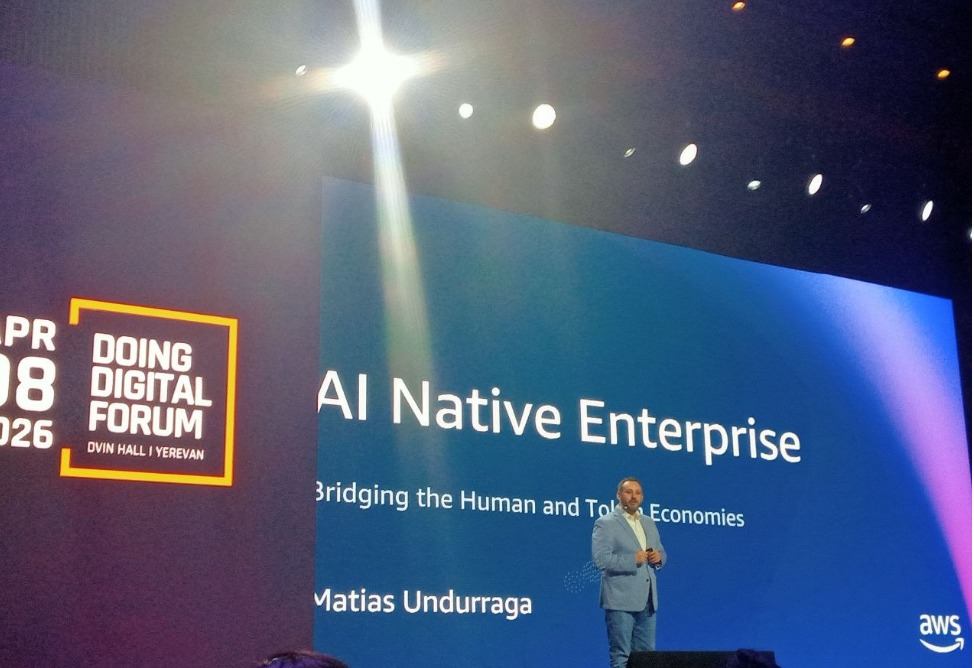
YEREVAN, April 8. /ARKA/. Artificial intelligence, in its impact on the economy and business, is comparable to the invention of electricity. However, its value is realized not when companies simply add a new tool to old processes, but when they rebuild the operating model itself. This is the central idea that Matias Undurraga, Head of Artificial Intelligence in Europe at Amazon Web Services, made central to his speech.
During Doing Digital 2026, which took place on Wednesday in Yerevan, he discussed the transition from digital transformation to the agent-based era, hybrid teams of humans and AI agents, the need for retraining, and why the main limitation to AI adoption is no longer models but the maturity of the organizations themselves.
According to him, today's businesses are gradually moving from using generative assistants to more complex systems. While in the early stages, AI helped create texts, code, and answer questions, now we're talking about agents capable of independently performing sequences of actions. Such systems can process data, interact with internal services, and perform tasks without constant human intervention. The next step is the emergence of entire agent-based ecosystems, where multiple AI components manage various functions and processes.
Against this backdrop, the structure of work within companies is also changing. A hybrid team model is emerging, in which humans and AI complement each other rather than compete. Employees are increasingly assuming task assignment, control, and coordination, while a significant portion of execution, analysis, and routine operations are transferred to automated systems. In this environment, the key risk is not job displacement, but the lag in adopting new tools.
Undurraga paid special attention to the economics of AI use. Companies are effectively entering a new cost model, where tokens—units of information processing in AI systems—are beginning to play a significant role. Despite the decreasing cost of models, the overall cost of solutions may increase due to the increasing complexity of the processes themselves: modern systems incorporate search, memory, verification, and additional processing layers. As a result, businesses are forced to re-balance the use of human labor, AI, and a combination of both.
The transition to the so-called AI-native model also requires organizational changes. These include accelerating decision-making, reducing dependence on hierarchies, and expanding team autonomy. In a situation where a significant portion of tasks can be performed by AI agents, excessive approvals begin to slow down processes. Therefore, companies are forced to reconsider their management approaches, emphasizing rapid experimentation and flexibility.
At the same time, accepting non-determinism is becoming an important element of the new reality. Unlike traditional IT systems, AI does not always produce the same result for the same request. However, as Undurraga notes, this characteristic should not be viewed as a defect. The challenge for businesses is not to achieve absolute predictability, but to learn how to manage risks, build control mechanisms, and safely test new solutions.
These changes are also affecting the labor market. According to the expert, artificial intelligence does not so much replace employees as enhance their capabilities. Specialists who master AI more quickly and are able to increase their productivity as a result gain a competitive advantage. As a result, skills in interacting with such systems are becoming a basic requirement.
Practical experience already confirms these trends. The use of AI agents allows for significantly faster development and reduced dependence on large teams. However, the key factor in efficiency remains the quality of task definition: the more precisely the goal and requirements are formulated, the more predictable the outcome.
Ultimately, as Undurraga emphasized, competitive advantage in the coming years will accrue not to those companies that formally implement artificial intelligence, but to those that can redesign their operating models, processes, and management approaches to it.
Key Points
AI is no longer just a convenient tool and is becoming the infrastructural foundation for a new stage of company development.
The winners will not be those organizations that formally implement AI, but those that manage to restructure their operating models, decision-making logic, system architecture, and work culture.
A key resource is not only access to models, but also a company's ability to manage tokens, risk, specifications, hybrid teams, and the speed of experimentation.
The decisive limitation remains not the quality of the models themselves, but the willingness of businesses to change their traditional way of working.
ARKA news agency is the forum's media partner.